


How CBSE Schools in Mehsana Can Help Students Explore Engineering Beyond the Usual Branches?
Engineering has always been one of the most respected career choices for students in India. For many families, it is associated with stability, problem-solving, technology, innovation and professional growth. However, the meaning of engineering is changing. Students today are not looking at only a few familiar branches. They are growing up in a world shaped by artificial intelligence, automation, robotics, electric mobility, clean energy, cybersecurity, data, smart devices and sustainable infrastructure.
This does not mean that traditional engineering branches are losing value. Civil, mechanical, electrical, electronics, chemical and computer engineering continue to remain important. Roads, bridges, machines, factories, power systems, software, manufacturing and infrastructure still need strong engineering talent. What is changing is that these fields are now expanding and connecting with newer technologies.
This is why CBSE schools in Mehsana should help students explore engineering beyond the usual branches. The aim is not to confuse students with too many options. The aim is to help them understand that engineering is becoming wider, more interdisciplinary and more connected to real-world challenges.
What are the usual engineering branches?
When students first hear about engineering, they usually hear about a few well-known branches. These include:
| Usual engineering branch | What it broadly involves |
|---|---|
| Civil engineering | Buildings, roads, bridges, construction, water systems and infrastructure |
| Mechanical engineering | Machines, manufacturing, design, energy systems and industrial processes |
| Electrical engineering | Power systems, circuits, motors, electrical machines and energy distribution |
| Electronics and communication engineering | Communication systems, circuits, devices, signals and embedded systems |
| Computer science engineering | Programming, software, systems, data, networks and digital applications |
| Chemical engineering | Industrial processes, chemicals, materials, energy and production systems |
These branches are still relevant. In fact, many new engineering areas grow out of these traditional foundations. For example, robotics connects with mechanical, electronics and computer science. Electric vehicles connect with mechanical, electrical, electronics, battery technology and software. Smart cities connect with civil engineering, data, sensors and sustainability.
So, students should not think of traditional branches and new branches as separate worlds. They should understand how they connect.
Why are new engineering branches coming up?
New branches are emerging because the problems engineers solve are changing. Earlier, an engineer may have worked mainly on machines, buildings, circuits or software. Today, many problems require a mix of these areas.
For example, a modern car is not only a mechanical product. It also has sensors, batteries, software, navigation systems, safety technology and data systems. A modern building is not only concrete and steel. It may include green design, smart lighting, energy monitoring, safety systems and digital planning. A factory may use robotics, automation, data analytics and artificial intelligence to improve production.
This is why new engineering fields are becoming important.
| Emerging engineering area | What students should understand |
|---|---|
| Artificial intelligence and machine learning | Machines and systems can be trained to recognise patterns and support decisions |
| Data science and analytics | Data can help solve problems in business, science, healthcare, finance and technology |
| Robotics and automation | Machines can be designed to perform tasks with precision and efficiency |
| Cybersecurity | Digital systems need protection from online threats and misuse |
| Internet of Things | Devices can connect, collect data and communicate with each other |
| Electric vehicles | Mobility is changing through batteries, motors, electronics and software |
| Renewable energy | Engineers are needed for solar, wind, storage and sustainable power systems |
| Biomedical engineering | Engineering can support healthcare devices, diagnostics and medical technology |
| Aerospace and drone technology | Design, control systems, materials and electronics are used in flight-related fields |
| Semiconductor and VLSI | Chips and electronics are central to modern devices and industries |
Why students should not be scared of new branches?
Many students feel nervous when they hear terms such as artificial intelligence, robotics, quantum computing or data science. These words may sound complex. Some students may think, "This is too difficult for me," or "Only very advanced students can understand this."
Schools should help students see these areas differently.
Every advanced field begins with simple foundations. Artificial intelligence begins with logic, maths, patterns and problem-solving. Robotics begins with machines, circuits, movement and coding. Cybersecurity begins with safe digital behaviour and understanding systems. Renewable energy begins with science, environment and energy concepts.
Students do not need to know everything immediately. They need curiosity, basic exposure and the confidence to keep learning.
The message should be clear: new engineering fields are not meant to scare students. They are meant to show students that the future has more possibilities.
Why early learning matters?
Career awareness should not begin only when students have to choose subjects in senior grades. By then, students may already feel pressure from marks, peer choices, family expectations or popular career options.
Early exposure helps students explore without fear. A student in middle school does not need to decide whether to become an AI engineer, civil engineer, robotics specialist or renewable energy expert. But the student can begin to understand how science, maths, technology, creativity and real-life problem-solving connect.
Early learning helps students:
| Area | How early exposure helps |
|---|---|
| Interest discovery | Students understand what they enjoy |
| Confidence | Students realise that difficult fields can be explored step by step |
| Subject connection | Students see how maths, science and technology support engineering |
| Better decisions | Students make subject choices with more awareness later |
| Reduced pressure | Students explore calmly instead of rushing in senior grades |
| Skill-building | Students begin developing problem-solving, curiosity and adaptability early |
CBSE's Skill Education curriculum also reflects the growing importance of career-linked learning. It includes subjects and modules such as Artificial Intelligence, Data Science, Information Technology and Design Thinking, which can help students gain early exposure to technology and future-ready skills.
Why agility matters in engineering careers?
In earlier times, students often thought that choosing one branch meant following one fixed career path. Today, career paths are more flexible. A mechanical engineer may work in robotics or electric vehicles. A civil engineer may work in smart infrastructure or sustainability. An electronics engineer may work in IoT, embedded systems or semiconductors. A computer science student may work in AI, cybersecurity, data science or product development.
This is why agility matters.
Agility means the ability to learn, unlearn, adapt and keep improving as technology changes. It does not mean changing direction randomly. It means staying open to new tools, new problems and new ways of working.
A student who is agile does not panic when a new technology appears. The student asks:
- What is this technology used for?
- Which subjects or skills connect with it?
- What basics do I need to understand first?
- How can I learn step by step?
- What problem does this technology solve?
This mindset is important because technology will continue to evolve. The students who succeed will not be the ones who know everything from the beginning. They will be the ones who keep learning.
Skills that help students stay agile
Schools can help students build agility by focusing on skills that remain useful even when technologies change.
| Skill | Why it matters |
|---|---|
| Concept clarity | Strong basics help students understand advanced topics later |
| Problem-solving | Engineering is about solving real problems |
| Curiosity | Students who ask questions learn faster |
| Critical thinking | Students learn to analyse before accepting an answer |
| Creativity | New solutions often need imagination |
| Digital literacy | Students become comfortable with tools and platforms |
| Communication | Engineers must explain ideas clearly |
| Teamwork | Modern engineering projects are rarely done alone |
| Resilience | Students learn to handle difficulty and keep trying |
| Ethical judgement | Technology should be used responsibly |
How schools and teachers can approach this?
CBSE schools in Mehsana can introduce engineering beyond the usual branches in a simple and age-appropriate way. The aim should not be to overload students with technical terms. The aim should be to build curiosity and awareness.
1. Connect engineering with everyday life
Teachers can show students how engineering appears in daily life. A bridge, water purifier, mobile phone, solar panel, lift, traffic signal, washing machine, medical device or app can become a learning example. This makes engineering feel practical rather than distant.
2. Use project-based learning
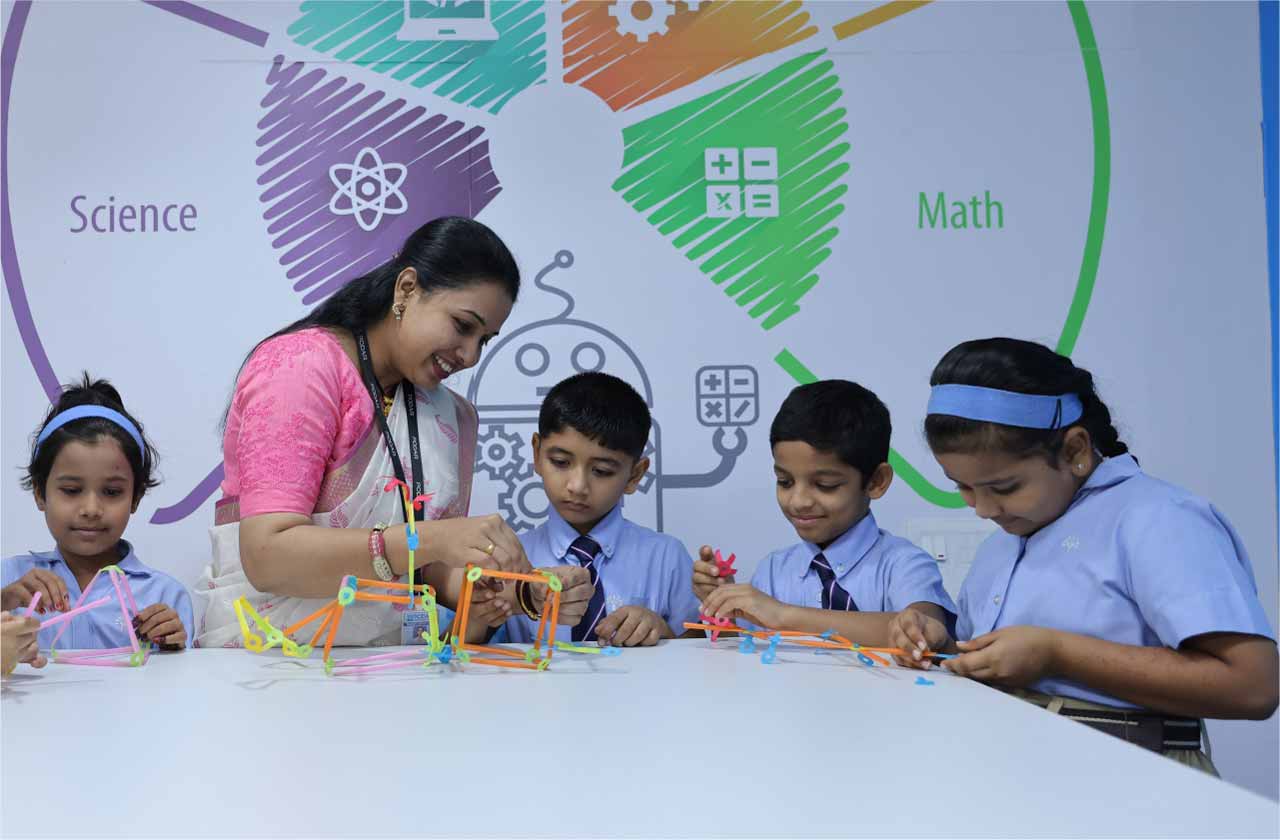
Projects can help students experience engineering thinking. Students can build models, design simple machines, create presentations, conduct experiments or solve local problems. These activities help them understand planning, testing, failure and improvement.
3. Introduce emerging fields through simple examples
Instead of explaining AI in a complex way, teachers can discuss how recommendation systems, voice assistants or smart cameras work at a basic level. Robotics can be introduced through movement, sensors and simple automation. Renewable energy can be introduced through solar panels and energy conservation.
4. Encourage interdisciplinary thinking
Teachers can help students see that engineering connects with many subjects. Maths helps in measurement and logic. Science helps in understanding materials, energy and systems. English helps in communication. Social science helps students understand society and real-world needs. Art and design help students think creatively.
5. Invite professionals and alumni
Schools can invite engineers, designers, entrepreneurs or technology professionals to speak with students. These sessions should explain not only success, but also learning paths, challenges, mistakes and the skills needed in different fields.
6. Teach students to research responsibly
Students may search online and find confusing information about careers. Teachers can guide them to compare sources, understand course requirements and avoid blindly following trends.
At Podar International School in Mehsana, we believe that students should receive early exposure to both traditional and emerging career possibilities. Engineering is a field that continues to evolve, and students need to understand that future opportunities may connect science, maths, technology, creativity, communication and real-world problem-solving.
Our approach is to encourage curiosity, concept clarity, digital awareness, project-based learning, communication, teamwork and adaptability through classroom learning and activities. The aim is not to pressure students into choosing a branch early. The aim is to help them explore possibilities, understand changing trends and build the agility needed for future careers.
For parents exploring CBSE school admission in Mehsana, career awareness should be an important factor. A school that helps students understand established branches, emerging fields and future-ready skills can support better decision-making. To know more about our school and the admission process, please get in touch with our team.
Email Address: admissions@podar.org
Telephone No: 6366437867
Topics


