


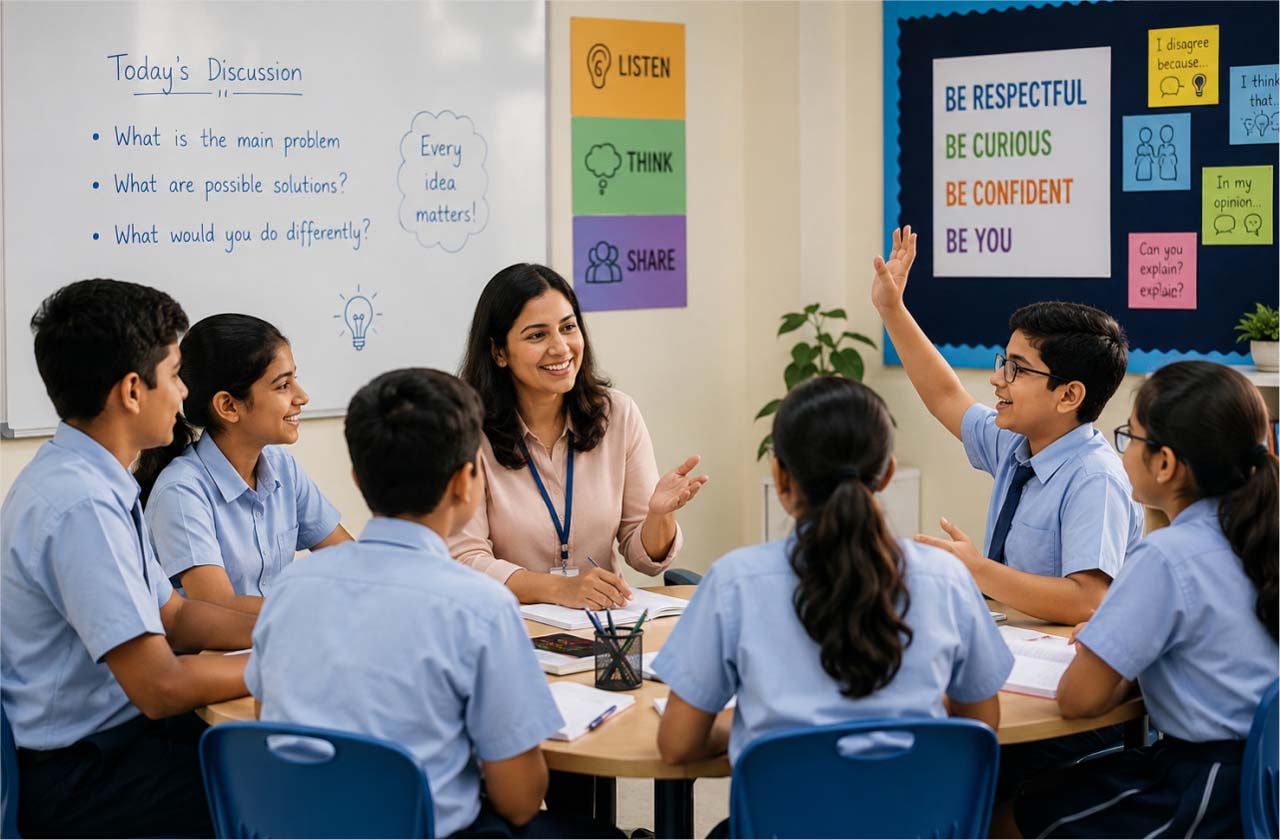
Why English Medium Schools in Nanded Should Encourage Independent Thinking
Education is not only about learning facts, completing homework, or scoring well in examinations. These are important, but students also need to learn how to think, question, understand, and make decisions. This is where independent thinking becomes important.
Independent thinking helps students look beyond memorised answers. It encourages them to ask why something happens, how a problem can be solved, and whether there is another way to understand a topic. For English medium schools in Nanded, encouraging independent thinking can help students become more confident, curious, and better prepared for future academic and life challenges.
What is independent thinking?
Independent thinking means the ability to form one's own understanding after listening, reading, observing, and reflecting. It does not mean ignoring teachers, parents, or textbooks. It means using guidance properly and then learning to think with clarity.
An independent thinker does not simply copy an answer because everyone else is writing it. The student tries to understand the concept. The student asks questions, connects ideas, and makes thoughtful choices.
| Independent thinking is | Independent thinking is not |
|---|---|
| Asking questions with respect | Arguing without understanding |
| Thinking before accepting an answer | Rejecting every instruction |
| Learning from teachers and then reflecting | Ignoring guidance |
| Making choices after understanding consequences | Doing whatever one wants |
| Solving problems with confidence | Acting without discipline |
This difference is important. Schools should help students understand that independent thinking and discipline can go together.
Do recognised education bodies support independent thinking?
Yes. While leading education bodies may not always use the exact phrase "independent thinking", the idea is strongly reflected in Indian and international education frameworks.
The National Education Policy 2020 encourages schools to move away from rote learning and towards real understanding and "learning how to learn". It also highlights the importance of critical thinking, inquiry-based learning, discovery-based learning, discussion, analysis, experiential learning, and 21st-century skills.
The National Curriculum Framework for School Education 2023 also refers to rational thought and independent thinking, including the ability to make choices based on rational analysis, creativity, and a grounded understanding of the world.
Internationally, the OECD Learning Compass 2030 focuses on student agency, well-being, and the knowledge, skills, attitudes, and values students need to thrive in the future. It also explains that students need to learn how to navigate unfamiliar contexts, instead of only receiving fixed instructions.
For English medium schools in Nanded, this means independent thinking should not be treated as an extra activity. It should be part of everyday classroom learning, project work, discussions, reflection, and teacher-student interaction.
Why students should learn independent thinking early
Students form learning habits from a young age. If they are only trained to memorise and repeat, they may struggle when they face new questions, unfamiliar situations, or real-life problems. They may wait for someone else to give them the answer.
Independent thinking helps students become more active learners. They do not depend only on instructions. They begin to take responsibility for their learning.
For example, when a student does not understand a maths problem, independent thinking helps the student try different methods, identify the mistake, and ask for specific help. When a student reads a story, independent thinking helps the student understand the characters, emotions, and message instead of only memorising the summary.
When students learn this early, they become more confident in higher classes.
Why rote learning alone is not enough
Rote learning may help students remember information for a short time. It may help them answer direct questions. However, it may not always help them understand concepts deeply.
If students only memorise, they may face difficulties when:
| Situation | Why rote learning may not help |
|---|---|
| The question is asked differently | The student may not know how to apply the concept |
| The topic needs explanation | The student may remember the answer but not understand it |
| A problem has more than one step | The student may not know how to think through the process |
| A real-life example is given | The student may not be able to connect textbook learning with life |
| A project or activity requires ideas | The student may wait for instructions instead of exploring |
This does not mean memory has no value. Students do need to remember facts, formulas, definitions, and rules. But memory should be supported by understanding. Independent thinking helps students use what they know in a better way.
How independent thinking improves classroom learning
When students think independently, classrooms become more engaging. Students ask better questions. They listen more actively. They participate in discussions. They also learn to explain their views with reasons.
This helps teachers understand how students are thinking. A student who gives a wrong answer may still be thinking in the right direction. A teacher can then guide the student towards the correct understanding. This kind of learning is more meaningful than simply marking an answer as right or wrong.
Independent thinking also helps students develop confidence. They learn that it is okay to try, make mistakes, correct themselves, and improve.
How leading English medium schools in Nanded can encourage independent thinking
English medium schools in Nanded can build independent thinking through everyday classroom practices. It does not always require a separate subject or special period. It can be included in regular teaching.
1. Encourage students to ask questions
Students should feel comfortable asking questions in class. Some students hesitate because they fear being judged. Teachers can help by creating a classroom culture where questions are welcomed.
A simple "Why do you think this happened?" or "Can there be another way to solve this?" can encourage students to think more deeply.
2. Connect lessons with real life
Students understand better when they see how lessons connect with the world around them. Science can be linked with health, nature, machines, food, or weather. Maths can be linked with shopping, sports, measurement, and planning. English can be linked with communication, storytelling, public speaking, and everyday expression.
When students see real-life connections, they begin to think beyond textbooks.
3. Use project-based learning
Projects allow students to research, plan, create, present, and reflect. They also teach students how to work with information instead of only reading it.
For example, a project on water conservation can help students study science, environment, civic responsibility, communication, and teamwork together. Such activities help students build observation and problem-solving skills.
4. Let students explain their thinking
Teachers can ask students to explain how they reached an answer. This helps students organise their thoughts. It also helps them understand that the process of thinking matters.
Even if the answer is incorrect, the explanation can show where the confusion began. This makes correction easier and more constructive.
5. Teach students to compare options
Independent thinking also involves decision-making. Students should learn to compare choices. For example, while writing an essay, they can compare two introductions. While solving a problem, they can compare two methods. While working in a group, they can discuss which idea is more practical.
This teaches students to think with reasons, not just preferences.
Role of teachers in building independent thinking
Teachers play a major role in shaping how students think. A teacher who only gives answers may make learning faster in the short term. But a teacher who guides students to think helps them become stronger learners in the long term.
Teachers can support independent thinking by:
| Teacher approach | How it helps students |
|---|---|
| Asking open-ended questions | Encourages students to think beyond one-word answers |
| Giving time to respond | Helps students think without pressure |
| Appreciating effort | Builds confidence to try |
| Discussing mistakes calmly | Helps students learn without fear |
| Encouraging multiple methods | Shows that problems can have different approaches |
| Connecting topics with life | Makes learning more meaningful |
This kind of teaching helps students become more thoughtful and confident.
Role of parents at home
Independent thinking should not be encouraged only at school. Parents can also support it at home through simple conversations.
Instead of giving quick answers, parents can ask:
- What do you think?
- Why do you feel this answer is correct?
- Can you explain it in your own words?
- What else can you try?
- What did you learn from this mistake?
These questions help students reflect. They also show that parents value thinking, not only marks.
Parents should also avoid doing every task for the student. Helping is important, but taking over can reduce confidence. Students need space to try, struggle, and learn.
Mistakes parents and schools should avoid
While encouraging independent thinking, adults should avoid certain mistakes.
| Mistake | Why it can be harmful | Better approach |
|---|---|---|
| Treating every question as disobedience | Students may stop asking questions | Encourage respectful questioning |
| Giving answers too quickly | Students may become dependent | Guide students to think step by step |
| Focusing only on marks | Students may avoid creative thinking | Appreciate effort, reasoning, and improvement |
| Criticising mistakes harshly | Students may fear trying | Use mistakes as learning moments |
| Comparing students | Confidence may reduce | Focus on individual progress |
| Allowing complete freedom without guidance | Students may become careless | Balance independence with responsibility |
Independent thinking needs support, structure, and patience.
Choosing English medium schools in Nanded that support independent thinking
Parents looking at English medium schools in Nanded should observe how a school encourages thinking, questioning, and participation. The right school should not only focus on completing the syllabus. It should also help students understand concepts, express ideas, and build confidence.
Parents can ask:
| Admission question | Why it matters |
|---|---|
| How does the school encourage students to ask questions? | Shows whether classroom culture is open |
| Are students given project-based learning opportunities? | Shows whether learning goes beyond textbooks |
| How do teachers handle mistakes? | Shows whether students can learn without fear |
| Are students encouraged to explain their answers? | Shows whether reasoning is valued |
| How does the school support different learning styles? | Shows whether students receive individual attention |
| Are classroom discussions encouraged? | Shows whether students can express themselves |
These questions can help parents understand whether the school supports both academic growth and thinking skills.
At Podar International School in Nanded, we encourage independent thinking because students need more than memorised knowledge. They need confidence, curiosity, judgement, and the ability to understand ideas deeply.
Independent thinking does not mean students stop listening to teachers or parents. It means they learn to listen, understand, reflect, and then respond thoughtfully. When schools and parents work together, students become more active learners and better decision-makers.
For parents exploring school admission in Nanded, our team is available to guide you through the admission process. Please get in touch with our team to know more about our school, facilities, and admission process.
Email Address: admissions@podar.org
Telephone No: 6366437873
Topics


