


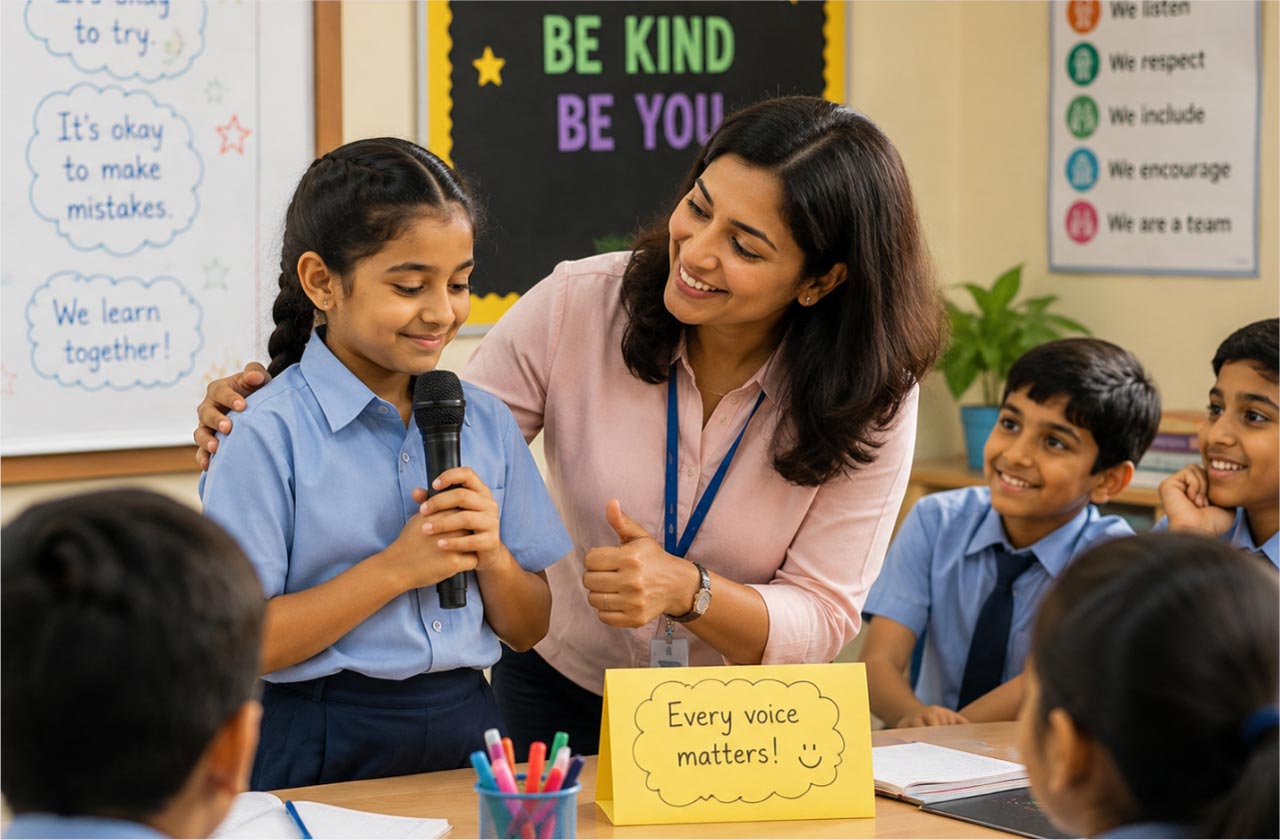
How CBSE Schools in Ujjain Should Help Shy Students Open Up
Some students enter a classroom and participate easily. They ask questions, speak in groups, volunteer for activities, and share their thoughts without much hesitation. Other students may take more time. They may know the answer but stay silent. They may want to join an activity but feel unsure. They may avoid attention even when they have the ability to do well.
This does not mean they are weak, uninterested, or less capable. They may simply be shy, cautious, sensitive, observant, or less comfortable in social situations.
For parents exploring CBSE schools in Ujjain, it is important to understand how a school supports shy students. A good school should not only encourage students who are already confident. It should also help quieter students feel safe, respected, and gradually ready to participate.
Understanding the difficulties shy students may face
Shy students may face difficulties that are not always visible. A student may want to answer a question but may feel the words are stuck. Another student may want to join a group activity but may not know how to start. Some students may worry that if they speak, others will notice their mistakes. This can make them choose silence even when they have ideas.
In classrooms, shy students may also get overlooked. Teachers may naturally notice students who speak more often. Group leaders may choose classmates who are already confident. During activities, quieter students may remain in the background even when they have useful ideas.
This can create a cycle. The less a student participates, the less confident the student may feel. Over time, the student may begin to believe, "I am not good at speaking," even though the real issue may be lack of safe opportunities.
Schools can break this cycle by noticing quiet students, giving them small chances to participate, and appreciating progress without pressure.
Can shy students face bullying or teasing?
It is important to frame this carefully. Not every shy student is bullied, and shyness should not automatically be treated as a sign of bullying. However, quieter students may sometimes find it harder to speak up if they are teased, excluded, or made uncomfortable by classmates.
For example, a shy student may not report if someone laughs at their answer, leaves them out of a group, or repeatedly makes comments about their silence. They may feel embarrassed, unsure, or worried that the situation will become worse if they complain.
This is why schools need a classroom culture where teasing, exclusion, and mocking are not treated as small matters. Students should know that they can approach a teacher, counsellor, or trusted adult if they feel uncomfortable. Teachers should also observe group behaviour carefully, especially when a student suddenly becomes more withdrawn or avoids certain classmates.
A safe school environment helps all students, but it is especially important for students who may not speak up easily.
Why schools should help shy students open up
School life is full of social and academic interactions. Students need to ask questions, work in groups, present ideas, speak to teachers, participate in activities, and build friendships. If a shy student remains unnoticed, the student may miss many opportunities to grow.
Helping shy students open up can support:
| Area | How it helps |
|---|---|
| Learning | Students ask doubts and understand concepts better |
| Confidence | Students feel more comfortable expressing themselves |
| Friendships | Students learn to interact with classmates |
| Participation | Students take part in activities beyond academics |
| Communication | Students practise speaking and listening |
| Emotional safety | Students feel seen, heard, and supported |
| Future readiness | Students build social confidence gradually |
Confidence does not develop suddenly. It grows through repeated small experiences where students feel safe to try.
Can teachers refer to any national or international frameworks?
There may not be a separate guideline only for "shy students". However, several national and international education frameworks support the larger idea of helping every student feel safe, included, confident, and able to participate.
The National Education Policy 2020 encourages schools to support holistic development. It highlights not only cognitive skills such as critical thinking and problem-solving, but also social and emotional skills such as empathy, perseverance, teamwork, leadership, and communication. This supports the need to create classrooms where quieter students are also encouraged to express themselves gradually.
UNESCO's work on social and emotional learning also highlights the importance of safe, supportive, and inclusive learning environments. Its Happy Schools Framework focuses on learner well-being, social-emotional learning, inclusion, mental health and psychosocial support, and student and teacher well-being. This is relevant for shy students because they often need a classroom culture where they are not judged, rushed, or ignored.
UNICEF India's life skills approach also includes confidence, communication, decision-making, empathy, teamwork, leadership, negotiation, problem-solving, and goal-setting. These are closely connected with helping shy students open up at their own pace. UNICEF also notes that life skills are best taught through participation, cooperation, real-life experience, safe environments, and targeted guidance.
For CBSE schools in Ujjain, this means support for shy students can be aligned with broader education goals such as emotional safety, inclusive participation, confidence-building, life skills, and student well-being. The aim is not to force shy students to become outspoken. The aim is to give them safe, gradual opportunities to speak, participate, ask questions, and feel included.
How teachers can use empathy
Empathy is one of the most important tools teachers can use with shy students. An empathetic teacher does not assume that silence means disinterest. The teacher tries to understand what may be stopping the student from participating.
For example, instead of saying, "Why do you never answer?", a teacher can say, "I noticed you had written something. Would you like to share it with me first?" This gives the student a smaller and safer step.
Empathy also means observing without labelling. A student should not be repeatedly called "shy" in front of others. This can make the student feel trapped in that identity. Teachers can use warmer language such as, "You are taking your time, and that is okay," or "Your ideas matter, even if you share them slowly."
Teachers can also use private conversations. A student who may not speak in front of classmates may be more comfortable speaking one-to-one. These conversations can help teachers understand whether the student is nervous, confused, worried about teasing, or simply needs more preparation time.
How top schools in Ujjain can support shy students
Leading schools in Ujjain can help shy students through simple but consistent classroom practices. The approach should be patient, inclusive, and respectful.
1. Create a safe classroom culture
A shy student is more likely to speak when the classroom feels safe. Teachers should make it clear that mistakes are part of learning. Students should not laugh at each other's answers, accents, mistakes, or hesitation.
When the classroom culture is respectful, shy students slowly begin to trust the space.
Teachers can say things like:
- "It is okay to try."
- "Mistakes help us learn."
- "Let us listen while someone is speaking."
- "Every student will get time to think."
Such simple habits can make a classroom more welcoming.
2. Give students time to respond
Some students need more time to think before answering. If teachers expect quick responses, shy students may remain silent even when they know the answer.
Teachers can help by giving thinking time. They can ask a question, allow students to write a short response, and then invite them to share. This reduces pressure and helps students organise their thoughts.
3. Use small group activities
Many shy students find it easier to speak in a small group than in front of the whole class. Group activities, pair discussions, reading circles, and project teams can help them participate more comfortably.
Teachers can also assign simple roles such as note-taker, reader, timekeeper, presenter, or organiser. This allows students to contribute in different ways.
4. Encourage participation beyond speaking
Participation does not always mean speaking loudly or performing on stage. A shy student may participate through writing, drawing, helping organise an activity, preparing a chart, asking a question privately, or contributing to a group project.
Schools should recognise different forms of participation. This helps students feel valued even before they become confident speakers.
5. Build confidence through predictable opportunities
Shy students may feel more comfortable when they know what to expect. Sudden attention can make them nervous. Planned opportunities can help them prepare.
For example, a teacher can tell a student in advance, "Tomorrow, I will ask you to read two lines," or "You can present one point from your group." This gives the student time to practise and feel ready.
Predictability reduces fear.
How schools can make participation more inclusive
Schools should ensure that participation opportunities are not limited only to naturally confident students. If the same students are always selected for speeches, competitions, assemblies, or leadership roles, quieter students may never get the chance to grow.
An inclusive school can provide different levels of participation.
| Level of participation | Example |
|---|---|
| Individual comfort | Writing answers, drawing, preparing notes |
| Pair participation | Reading with a partner, discussing a question |
| Small group participation | Group projects, role-based activities |
| Classroom participation | Answering questions, presenting short points |
| Larger participation | Assembly, competitions, stage activities |
This gradual model helps shy students build confidence step by step.
What parents should ask during admission
Parents exploring CBSE schools in Ujjain can ask specific questions about how the school supports shy or hesitant students.
| Question parents can ask | Why it matters |
|---|---|
| How do teachers encourage quiet students to participate? | Shows whether participation is inclusive |
| Are students forced to speak or guided gradually? | Shows the school's sensitivity |
| How does the school handle classroom teasing or laughter? | Shows whether emotional safety is protected |
| Are small group activities used in class? | Helps shy students participate comfortably |
| Are there different ways for students to express themselves? | Supports different personalities |
| How do teachers communicate with parents about confidence issues? | Shows school-home collaboration |
| Is counselling or student support available? | Helps students who need extra guidance |
| Are shy students given activity opportunities? | Shows whether all students are included |
These questions help parents understand whether the school supports every type of learner.
At Podar International School in Ujjain, our approach is to help every student feel safe, included, and confident in the classroom. We believe that students open up better when they know they will be heard with patience and treated with respect. Our teachers work towards creating safe classrooms where students are encouraged to ask questions, participate gradually, and express themselves without fear of being laughed at or judged.
We also place strong emphasis on respectful peer behaviour. Bullying, teasing, exclusion, and mocking are not treated as minor issues, because they can affect a student's confidence and emotional comfort. Teachers observe classroom interactions carefully and guide students to listen, include others, and behave with empathy. This helps create an environment where shy and hesitant students feel supported enough to take small steps towards participation.
The aim is not to force students to become outspoken overnight. The aim is to give them the right encouragement, safe opportunities, and consistent support so that they can build confidence at their own pace. To know more about our school and the admission process, please get in touch with our team. We will be happy to guide parents and share how the school creates a supportive environment where students can learn, participate, and grow at their own pace. Here are our contact details:
Email Address: admissions@podar.org
Telephone No: 6366437893
Topics


