


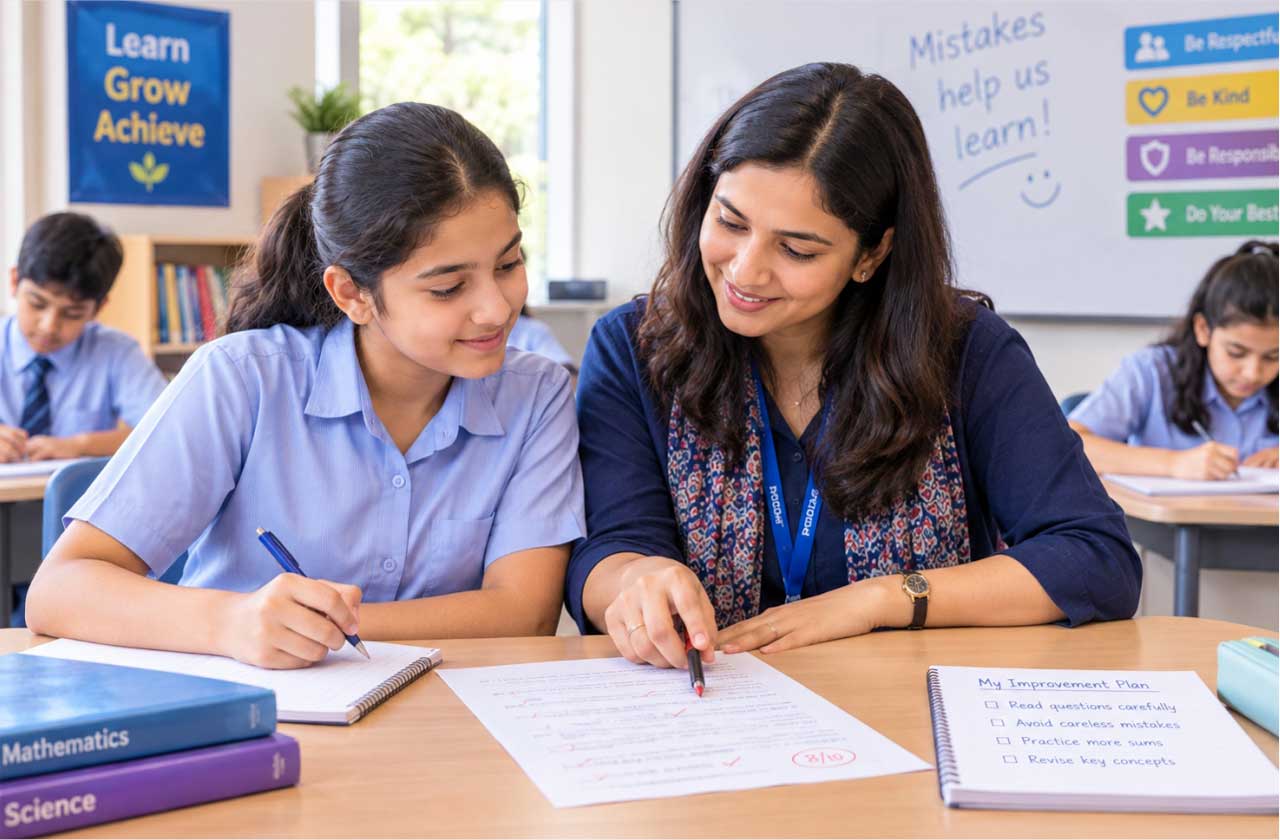
A poor test result can feel very personal for a student. Some students may feel they have let their parents down. Some may feel nervous about facing the teacher. Others may quietly compare themselves with classmates and begin to doubt their own ability. At that moment, students need guidance more than criticism.
A poor result does not always mean that a student has not tried. Sometimes, the concept was not clear. Sometimes, the student understood the answer but could not write it properly. Sometimes, exam pressure, careless mistakes or weak revision affected the performance. This is why schools in Washim should help students look at poor test results with care and clarity. Marks should not become a label. They should become a starting point for improvement.
Why poor test results affect students?
A poor result can affect:
| Area | How it may affect students |
|---|---|
| Confidence | Students may doubt their ability. |
| Motivation | Students may feel less interested in trying again. |
| Classroom participation | Students may avoid answering questions. |
| Subject interest | Students may start disliking the subject. |
| Parent communication | Students may feel scared to share marks. |
| Peer relationships | Students may compare themselves with friends. |
| Study habits | Students may not know what to change. |
This is why schools and parents should respond carefully.
Poor marks should be seen as feedback
A test result should not only tell students how many marks they lost. It should help them understand why they lost those marks.
- Did the student misunderstand the concept?
- Did the student forget the steps?
- Did the student rush?
- Did the student make careless errors?
- Did the student not revise enough?
- Did the student know the answer but write it poorly?
These questions turn marks into learning.
The National Education Policy 2020 supports this broader view of assessment. It emphasises continuous assessment, real understanding and critical thinking over rote memorisation. It also highlights conceptual clarity, critical thinking and higher-order skills. This means schools in Washim should not treat tests only as judgement. They should use them to guide improvement.
What Indian education guidance says?
There may not be one Ministry of Education guideline only for “poor test results”. However, Indian education policy and CBSE assessment initiatives clearly support feedback-based improvement.
CBSE’s SAFAL initiative says assessment should provide diagnostic information about student learning. It also says results should largely be used for development feedback and not only for promotion. SAFAL mentions that schools can use assessment data to identify learning gaps, adjust teaching methods and provide targeted academic support.
The National Curriculum Framework for School Education 2023 also supports assessment for learning. It refers to feedback, student response analysis, peer assessment, self-assessment and identifying misconceptions or errors.
The Ministry of Education’s Manodarpan initiative also recognises student mental health and emotional well-being. It includes advisory support, counselling services, helplines and psychosocial resources for students, teachers and families. It also notes CBSE’s pre-exam and post-result tele-counselling support.
Together, these references show one important point. Results should not only create pressure. They should guide learning, support students emotionally and help schools plan better academic support.
How teachers in Washim can help students understand where they went wrong?
Teachers play a key role after poor test results. Their feedback can either discourage students or help them improve. A teacher should not only say, “You need to study more.” That is too broad. Students need specific feedback.
1. When the problem is understanding
| Student Issue | What it may look like | Helpful Teacher Feedback | What the Student Can Do Next |
|---|---|---|---|
| Concept is unclear | The main idea in the answer is incorrect. | “You have tried the question, but the concept needs more clarity. Let us revise it with examples.” | Revisit the basics. Ask for one more explanation. Practise similar questions. |
| Difficulty applying concepts | The student remembers definitions but struggles with application-based questions. | “You remember the topic, but we need to practise how to apply it in different situations.” | Solve example-based questions. Connect the concept with real-life examples. |
2. When the problem is answer writing
| Student Issue | What it may look like | Helpful Teacher Feedback | What the Student Can Do Next |
|---|---|---|---|
| Answer is incomplete | The student writes only part of the answer. | “You understood the main point, but your answer needs more explanation.” | Add examples, keywords and supporting points. |
| Weak presentation | The answer has useful points but lacks order. | “Your points are useful, but the answer needs clearer structure.” | Write in a proper sequence. Use short points or steps where needed. |
| Lack of examples | The answer is correct but not strong enough. | “Your answer is on the right track. Adding an example will make it stronger.” | Add a textbook example, classroom example or real-life example. |
| Weak step-by-step method | The student jumps to the final answer. | “The final answer may be close, but you need to show the steps clearly.” | Write each step. Do not skip the method. |
3. When the problem is exam habits
| Student Issue | What it may look like | Helpful Teacher Feedback | What the Student Can Do Next |
|---|---|---|---|
| Careless mistakes | The student knows the method but loses marks due to small errors. | “Your understanding is better than your marks show. Slow down and check each step.” | Keep time for checking. Review calculations, spellings and steps. |
| Weak time management | The student spends too long on one question. | “You were able to answer, but time management affected the rest of the paper.” | Divide time before starting. Move ahead if one question takes too long. |
| Poor revision | The student forgets earlier topics. | “You may need a better revision routine. Let us plan shorter revision sessions.” | Revise daily in small parts. Make quick notes. Review difficult topics again. |
4. When the problem is confidence or pressure
| Student Issue | What it may look like | Helpful Teacher Feedback | What the Student Can Do Next |
|---|---|---|---|
| Exam anxiety | The student knows the answer but rushes during the test. | “You knew this answer, but you rushed because of pressure. Let us practise calmly.” | Practise timed answers. Read each question slowly. Start with easier questions. |
| Low confidence after marks | The student feels upset and avoids discussing the paper. | “One result does not define your ability. Let us understand the mistakes and improve one area first.” | Start with one small correction goal. Ask for help instead of avoiding the subject. |
| Fear of feedback | The student does not want to review the test paper. | “Feedback is not here to discourage you. It is here to show the next step.” | Read the feedback calmly. Ask what can be improved first. |
This kind of feedback helps students see poor results more clearly. They understand whether the issue is concept clarity, answer writing, exam habits or confidence. Once the problem is clear, improvement feels more possible.
Specific feedback helps students know what to do next.
Why students need to be proactive?
Feedback is useful only when students act on it. They should not keep the corrected paper aside and move on.
Students should learn to review their test paper carefully. They should ask where they went wrong. They should understand whether the problem was knowledge, practice, writing, speed, confidence or attention.
Students can ask teachers:
- Which mistakes happened most often?
- Which topic should I revise first?
- Did I lose marks because of concept clarity or answer writing?
- How can I improve this type of answer?
- What should I practise before the next test?
- Can I try one corrected answer again?
- How should I avoid the same mistake next time?
These questions help students take ownership. A proactive student does not wait for someone else to fix the problem. The student learns to ask, understand and improve.
How parents should respond to poor test results?
Parents are important in this process. Their first reaction matters. If parents react with anger, comparison or disappointment, students may become scared. They may stop sharing results honestly. They may also begin to see marks as a threat. Parents can respond better by asking calm questions.
- What did you find difficult?
- Did you understand the teacher’s feedback?
- Which mistake can you correct first?
- Do you need help with revision?
- What is one goal before the next test?
Parents should avoid saying, “Why did your friend score more?” This creates peer comparison. It does not help learning. A better response is, “Let us understand what went wrong and what you can do next.”
Why peer comparison is harmful after poor test results?
Peer comparison makes students focus on others instead of their own growth. It can make them feel jealous, ashamed or discouraged.
Every student has different strengths. One student may be good at maths. Another may be strong in writing. Another may need more time to understand science. Another may improve slowly but steadily.
Teacher feedback should not be used to compare students. It should be used to guide each student’s progress.
Parents should also understand this during school admission conversations. They should ask how the school supports students after low marks. They should also ask whether teachers focus on personal improvement instead of public comparison.
Questions parents can ask during school admission
During school admission in Washim, parents can ask how the school supports students after poor test results.
Useful questions include:
- How does the school give feedback after tests?
- Do teachers discuss learning gaps?
- Is there support for students who repeatedly score low?
- How does the school avoid peer comparison?
- Are parents informed about improvement areas?
- Does the school support students emotionally after poor results?
- Are students encouraged to ask doubts after tests?
- How does the school help students plan for the next assessment?
These questions help parents understand whether the school treats results as part of learning.
At Podar International School in Washim, the focus is on helping students learn from every academic experience. Test results are used not only to measure performance but also to guide improvement. Teachers help students understand their strengths, mistakes and learning gaps. Students are encouraged to ask questions, accept feedback, revise carefully and take responsibility for their progress. The school also works closely with parents. This helps students receive consistent support at home and in the classroom.
To know more about Podar International School in Washim and the admission process, please get in touch with the team.
Email Address: admissions@podar.org
Telephone No: 6366437896

